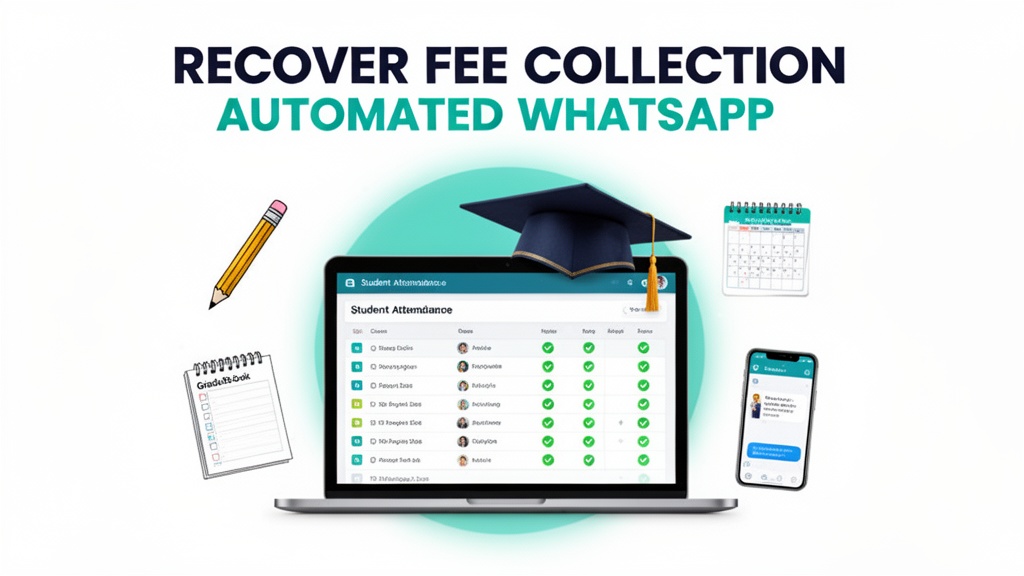
It's the 25th of the month. Your school in Riyadh has 1,200 active students and their families. Your finance team has 15 staff members working full-time on fee collection. They've called 240 parents this week — and 156 didn't answer. Of those who did answer, only 42 paid. The rest said they'd send payment by tomorrow, then went silent. Meanwhile, the school administration is preparing for upcoming exams, and the principal is asking why revenue collection is lagging behind the 7-month rolling average. This is a Tuesday. Every school administrator in Riyadh knows this day.
The Problem With Manual Fee Collection in Saudi Schools
Saudi Arabian schools lose an estimated 25-35% of annual tuition fees to uncollected payments, and the problem has worsened as parents' payment habits have shifted away from cash. A typical secondary school in Riyadh with 1,000 students faces losses of SAR 2.5 million to 3.5 million annually from unpaid fees. The root cause isn't poor payment discipline — it's that parents are busy, forgetful, and prefer digital payment methods, but schools still rely on manual follow-up through phone calls and paper notices.
The manual process is broken at multiple levels. When the finance officer makes a phone call, they're relying on memory to recall who paid, who hasn't, and what payment plans remain. If the payment reminder slips through, it goes to a pile of unprocessed envelopes or an outdated spreadsheet. By the time the finance team realizes the fee is overdue, 15 to 30 days have passed — a critical window where parents are more likely to negotiate payment plans or file for exemption.
The cost goes beyond the lost revenue. Each parent who doesn't pay on time requires at least 3 follow-up calls, consuming 45 minutes of staff time per parent per week. Multiply that by 300 outstanding payments per month, and you're looking at 112.5 hours of staff time per month just chasing invoices. That's equivalent to 14 full-time employees whose work isn't generating revenue. When parents repeatedly miss deadlines without reminders, trust erodes — they start questioning why the school can't maintain a reliable billing system, even if the problem is their own payment behavior.
What the School Management Software Actually Does
The school management software processes all fee-related operations through a centralized digital platform that runs on any browser with internet access. When a school administrator logs in, they see a dashboard showing all outstanding payments grouped by student ID, class, and payment status. The system automatically generates a payment reminder for each student whose fee is due in 7 days, 3 days, and 1 day before the due date.
The key difference between this software and manual collection is that the reminders go directly to parents' WhatsApp numbers — not the school's general phone line. Each reminder includes a link that opens a pre-filled payment page where parents can complete the transaction in under 60 seconds using their preferred bank's online portal or an installment plan configured by the school. The payment is recorded instantly in the system, and the reminder status is updated to "payment link sent." Parents who don't respond to the first reminder receive a second, more urgent message three days later. Those who still don't pay get a final reminder the day before the due date expires.
When a payment is completed, the school receives an instant notification with the transaction ID, amount, and payment method. The finance officer no longer needs to manually verify if a check arrived or call parents to confirm payment. All financial data is centralized in a single dashboard, where revenue collection rates, outstanding balances, and default trends can be viewed in real time. The system also generates weekly and monthly reports that highlight payment patterns, allowing the school to identify which classes or grade levels are struggling with collection and intervene early.
Key Features With Real Use Cases
Automated Fee Collection and Payment Reminders
The software sends WhatsApp messages to parents whose fees are due within 7 days. The message says: "Dear [Parent Name], your child [Student Name]'s school fee payment for the current term is due on [Date]. To avoid late payment charges, please complete your payment using this link: [Payment Link]. If you've already paid, please ignore this message. Thank you for your cooperation." When the parent clicks the link, they're taken to a secure payment page where they can select their preferred payment method and complete the transaction. The system automatically tracks payment history and prevents duplicate reminders for paid invoices.
Digital Attendance With Automated Parent SMS/WhatsApp Alerts
Instead of a paper attendance sheet, teachers mark attendance daily on their tablet or phone. As soon as the class period ends, the system sends an immediate WhatsApp message to the parents of absent students: "Dear [Parent Name], [Student Name] was marked absent in [Subject/Class] today. Please ensure they attend school tomorrow. If this absence is due to a medical emergency, please provide a note from your doctor." This reduces parent complaints and increases school accountability, since the absence is documented the moment it's marked.
Parent Portal for Progress Tracking and Communication
Each parent receives a login to a secure portal where they can view their child's attendance record, fee payment status, exam results, and teacher messages. When a teacher uploads a student's test paper with marks, the portal shows a color-coded report card that highlights strengths and areas for improvement. Parents can also send direct messages to teachers through the portal, eliminating the need to call the school administration for routine queries about homework, attendance, or upcoming deadlines.
Online Exam Management and Grade Publishing
The system allows teachers to upload exam papers, configure question banks, and automate grade calculations. When exams are completed, teachers can publish results directly to the parent portal. Each parent receives a WhatsApp notification: "Dear [Parent Name], [Student Name]'s exam results for [Subject] are now available on the parent portal. Login at [Portal Link] to view the detailed breakdown." This reduces the administrative burden of printing and distributing paper reports, while also providing parents with instant access to academic performance data.
| Stat | Value |
|------|-------|
| Annual tuition lost to uncollected fees | 25-35% |
| WhatsApp open rate in Saudi Arabia | 95%+ |
| Fee collection improvement with automation | 60-75% |
Local Market Context: Saudi Arabia
Saudi schools operate in a highly competitive education market where parents have multiple private school options. Many parents now prefer digital payments and expect schools to provide convenient payment methods. According to the Saudi Central Bank, over 85% of transactions in the country are now conducted through digital channels, including banks, mobile wallets, and online portals. Schools that don't align with this shift risk losing parents who expect the same digital convenience they experience in retail, healthcare, and entertainment.
The Saudi Vision 2030 reforms have accelerated digital transformation across all sectors, including education. Schools are under increasing pressure to modernize their operations and reduce paperwork. The government has introduced initiatives to digitize public services, and private schools are expected to follow suit to remain competitive. WhatsApp is the dominant messaging platform in Saudi Arabia, with over 40 million users who spend an average of 90 minutes per day on the app. Its high penetration and ubiquitous presence make it the most effective channel for parent communication.
Payment behavior in Saudi Arabia has also shifted. Cash payments are declining, especially among younger parents who grew up with digital banking. However, many parents are uncomfortable entering financial details on websites they don't trust. Schools that integrate with verified payment gateways and use secure QR codes can build trust and increase payment conversion. The combination of digital preference and high smartphone penetration creates a strong case for schools to adopt automated payment reminders through WhatsApp.
How to Get Started
- Export your current fee payment records from your spreadsheet or accounting software into CSV format. Ensure each row contains the student ID, parent WhatsApp number, amount due, and due date.
- Schedule a 45-minute demonstration with Ubisky and request a custom import template that matches your data structure. Ask to see a mock import with your actual data to confirm the system handles your records correctly.
- During the demo, ask the sales team to show you the WhatsApp reminder workflow using a test number. Verify that the message template includes your school's name, the student's name, the due date, and a secure payment link.
- Request a 14-day pilot with your top 50 active students whose parents have WhatsApp. Set up the automatic reminder schedule for 7 days before due date, and monitor the response rate over the pilot period.
- Compare the renewal rate and total amount collected in week 1 of the pilot against your previous month's average. If your recovery rate is 60-75% higher than manual collection, extend the pilot to include all classes before full implementation.
> Book a free demo — we'll show you how Saudi schools use Ubisky to automate fee reminders and recover 25% more revenue.
Join 400+ businesses across GCC, Africa and South Asia already using Ubisky. Free 30-day trial — no credit card required.
Book a Free Demo | Explore School Management System
Frequently Asked Questions
Can Ubisky send fee reminders in Arabic for our Saudi Arabian parents?
Yes. The system supports multiple languages, including Arabic. You can configure the reminder messages in Arabic, and the parent portal can be set to display content in Arabic or English based on each parent's language preference.
Does the school software integrate with local payment methods like STC Pay or SADAD?
Yes, Ubisky integrates with major payment gateways in Saudi Arabia, including STC Pay, SADAD, and bank payment portals. You can configure each payment method as a payment option, and parents can select their preferred channel during checkout.
How do we migrate our existing fee records during setup?
We provide a CSV import template that matches most common fee structures. If your data format is complex, our team can build a custom import script that maps your existing fields to our system. For schools with 1,000+ students, we offer a phased migration where the system processes your records in batches to minimize disruption.
Can we manage multiple school branches from a single account?
Yes. Each school branch is configured as a separate entity with its own fees, staff, and student records. All branches are visible in a central dashboard, allowing finance managers to view collection status across locations and consolidate reports as needed.
What happens to member data if we cancel the subscription?
You retain full ownership of your data. Before cancellation, you can export all fee records, student information, and attendance history in CSV or PDF format. We also provide a backup export if you need to migrate to another system in the future.
---
A consistent fee collection process doesn't just recover revenue — it strengthens trust between your school and parents. With automated WhatsApp reminders, your finance team spends less time chasing payments and more time on strategic planning. Contact Ubisky today to see how Saudi schools across Riyadh, Jeddah, and Dammam are recovering 25% more fees through automation.
See School Management System in Action
Join 400+ businesses across GCC, Africa & South Asia already using Ubisky.
Free 30-day trial — no credit card required.