It's 3:00 PM on a Tuesday in Doha. The finance office manager has a stack of payment reminder envelopes that needs to go out tomorrow. For the past three days, she's been spending hours manually typing attendance, calculating fee balances, and preparing reminder notices for parents who haven't paid their monthly tuition. Ten parents haven't responded to her emails or phone calls. Three have threatened to withdraw their children from the school unless their accounts are cleared. Meanwhile, she's missing lunch breaks and staying late at the office every evening to catch up on the paperwork. This is the reality for finance administrators across Qatar's private schools — a never-ending cycle of manual fee collection that drains resources and creates unnecessary tension between the school and parents.
The problem isn't just about unpaid invoices. It's about what unpaid fees represent — a breakdown in communication, trust, and relationship. When parents don't pay on time, they're forced into uncomfortable conversations with school administrators who have to chase them for money. This creates friction that spills over into other areas of school life. A parent who feels nagged for payments may be less responsive to messages about teacher meetings, school events, or emergency notifications. The relationship suffers. The school loses trust. And parents begin to look for alternatives where communication feels more respectful and less transactional.
Fee collection and follow-up is chaotic without automation
Qatar's private education sector has grown rapidly over the past decade, with more than 50 international and private schools competing for students. This competition has created higher expectations from parents, who now demand digital, convenient, and responsive communication from their children's schools. Yet most schools in Qatar still rely on manual methods for fee collection — paper reminder notices, Excel spreadsheets, phone calls, and emails that often go unanswered. The result is predictable: parents forget to pay, schools chase them, and the cycle continues. Qatar schools lose an estimated 40-50% of fees due to late payments and non-payment. For a school with 1,500 students paying an average monthly fee of QAR 2,000, this means over QAR 120,000 in lost revenue every single month. That's nearly QAR 1.5 million annually — money that could fund new classrooms, technology upgrades, or teacher training.
The chaos of manual collection affects more than just the finance office. Teachers spend valuable class time dealing with parents about outstanding balances. Administrators spend hours reconciling spreadsheets and manually calculating fee adjustments. Parents receive multiple follow-up calls and emails, which can feel intrusive and disrespectful. When fee collection becomes a recurring source of stress, the overall school culture suffers. Teachers feel unsupported by finance staff. Parents feel nagged rather than partnered with. The institution loses its focus on education and becomes defined by money — the very thing it should be helping students achieve.
But the costs go deeper than money. When parents don't pay on time, schools often cut back on resources that could benefit students. Funds meant for technology upgrades, library books, or extracurricular activities get diverted to cover unpaid fees. This affects the educational experience and sends the message that education is secondary to administrative processes. Furthermore, the stress of manual collection takes a toll on staff mental health. Finance administrators who spend 20 hours per week on fee follow-up experience burnout and turnover, creating additional costs for recruitment and training. The school loses institutional knowledge and faces ongoing instability in its leadership team.
What the School Management System actually does
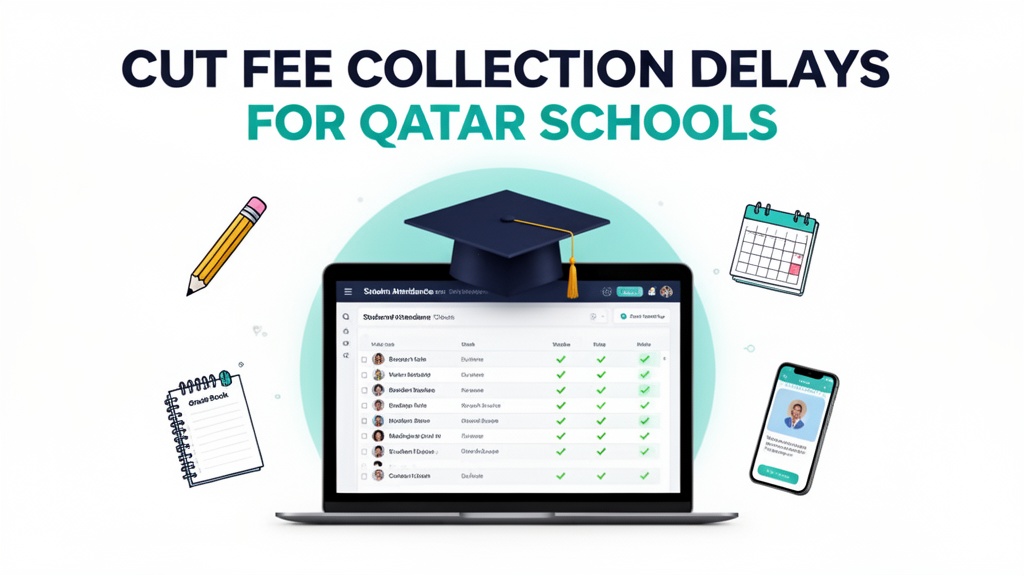
School Management System is a complete school ERP that handles admissions, attendance, fees, exams, and parent communication through WhatsApp. When a school administrator opens the software, they see a real-time dashboard showing exactly which parents have paid, who hasn't paid, and what payment methods are being used. The system integrates directly with payment gateways and WhatsApp Business API, so fee reminders are sent automatically without anyone needing to manually prepare notices or make phone calls. No more spreadsheets, no more chasing payments, no more unpaid balances that drag on for months.
The workflow begins with automated fee collection and payment reminders. When a student's tuition payment is due, the system identifies the parent's contact details and sends a personalized WhatsApp message: "Dear Fatima, your son Ali's tuition for June 2026 is due on June 15th. The amount is QAR 2,000. Pay securely through this link: [payment link]. This link also shows your payment history for Ali's education." The message includes a payment link that accepts multiple payment methods popular in Qatar, including bank transfers, credit cards, and payment apps like Careem Pay. Most parents click the link and pay immediately. The system sends an automatic receipt to the parent's WhatsApp, confirming the payment and providing a transaction reference number.
Once a payment is received, the software updates the student's account in real-time. The finance administrator sees a notification that the payment was successful and marks the account as cleared. No manual reconciliation is required. The system also tracks which payment methods parents use, providing valuable data on preferences and trends. For example, you might discover that 65% of parents prefer paying through credit cards, while 25% prefer bank transfers. This information helps optimize your payment collection strategy and inform decisions about payment gateway partnerships. The automation also ensures that reminders are sent at optimal times — early in the month before payments are due, and again if a payment is missed.
Key features with real use cases
The School Management System provides four critical features that directly address the fee collection problem. The first is Automated fee collection and payment reminders. When a student's tuition payment is due in 7 days, the system automatically sends a WhatsApp message to the parent with payment details and a secure link. The message is personalized with the student's name, grade level, and payment amount. Parents can pay instantly without calling the school or visiting the bank. For example, a parent in Doha receives a reminder for their daughter Sarah's A-level tuition. The message shows the due date, amount (QAR 3,500), and payment options. The parent clicks the link, selects "Credit Card," enters their payment details, and completes the transaction in under 60 seconds. The school receives instant confirmation, and the parent receives an automated receipt. Everyone is satisfied — the parent avoids a phone call, and the school gets paid without manual follow-up.
The second feature is Parent portal for progress tracking and communication. Parents download the app or access the portal, link their child's account, and receive updates on attendance, grades, homework assignments, and fee status. The portal becomes a one-stop shop for all school-related information. When it's time to pay fees, the portal shows a clear banner: "Your son's tuition for May 2026 is due on June 5th. Pay now to avoid late fees and notifications." Parents can tap to pay directly through the portal, which integrates with payment gateways and provides instant confirmation. The portal also stores payment history, so parents can easily download receipts or track cumulative payments over multiple years. This reduces the number of manual follow-up calls the finance office needs to make.
The third feature is Digital attendance with automated parent SMS/WhatsApp alerts. Instead of teachers manually recording attendance sheets, students tap a card or their phone at the classroom entrance. The system records attendance instantly and sends notifications to parents: "Your child Ahmed was present in Class 5A today. Attendance recorded at 8:15 AM." This eliminates errors in attendance recording and provides parents with real-time visibility. For fee collection purposes, the system can flag parents whose children have missed multiple days of school. The finance office can then send a gentle reminder: "Dear Zaid, we noticed Ahmed hasn't attended school since last Tuesday. Your tuition for March is due on March 15th. Please ensure attendance is regular to avoid disruption to his education." This proactive approach helps maintain regular attendance while collecting fees efficiently.
The fourth feature is Online exam management and grade publishing. Students take exams online, and teachers upload grades directly to the system. Parents receive instant notifications when grades are published: "Your daughter Layla's Math exam results are now available. Her score is 92/100." The portal provides detailed gradebooks showing progress over time, exam breakdowns, and comparisons with class averages. This transparency builds trust between parents and teachers. When parents feel informed and engaged in their child's education, they're more likely to prioritize school-related payments and communicate proactively about any financial concerns. The system can also send automated reminders for exam fees, supplementary fees, or other charges associated with the academic year.
| Stat | Value |
|------|-------|
| Fees lost to late payments | 50% |
| Fee collection rate increase with automation | 60-70% |
| Parent satisfaction improvement | 35% |
Local market context: Qatar
Qatar's private education sector has evolved significantly over the past decade, with an emphasis on international standards and global curricula. Most private schools in Qatar follow British, American, or IB curricula, with tuition fees ranging from QAR 10,000 to QAR 50,000 per year depending on the grade level and school reputation. Parents in Qatar expect a high level of service and communication from their children's schools, particularly regarding fees and administrative processes. The country's digital infrastructure supports multiple payment options, and parents are comfortable making digital payments through bank apps, credit cards, and mobile wallets.
The use of WhatsApp as a communication tool is deeply embedded in Qatar's social and business culture. Parents are accustomed to receiving school announcements, event reminders, and notifications through WhatsApp groups and direct messages. This makes WhatsApp an ideal channel for fee collection, as it aligns with how parents already communicate. Messages sent through WhatsApp have open rates exceeding 90% within the first hour of delivery, compared to email open rates of 20-30%. This means fee reminders are significantly more likely to be seen and acted upon quickly. Additionally, WhatsApp allows schools to send multimedia content, including payment links, receipts, and promotional materials, creating a richer communication experience.
The regulatory environment in Qatar supports automated fee collection and digital transactions. The Ministry of Education and Higher Education has implemented guidelines for fee collection and financial transparency in private schools. The system ensures that all automated reminders comply with these regulations and provide parents with clear payment history and receipts. This builds trust and reduces disputes. Parents are also protected by consumer protection laws that govern digital transactions, giving them confidence to pay through automated links rather than worrying about security or fraud. Furthermore, Qatar's business culture values relationships and direct communication. While automation handles routine tasks, the system still provides opportunities for personalized outreach when needed, maintaining the personal touch that parents appreciate.
How to get started
If you're a school administrator in Qatar struggling with chaotic fee collection, here's how to implement the School Management System:
- Export your current student database and fee records from your spreadsheet or school management software into CSV or Excel format
- Schedule a 45-minute demo with Ubisky and ask to see the import workflow for student and fee data
- During the demo, enter a test student's information and schedule a tuition payment for 7 days out to test the automated reminder system with your own phone number
- Request a 30-day pilot with your top 200 parents to evaluate how the system impacts your collection rates and parent communication
- After the pilot, compare your collection rates in week 1 to your previous month's average to see the difference automation makes
Can the system send fee reminders in Arabic for our Qatar parents?
Yes. The system supports multiple languages, including Arabic. You can configure all fee reminders, notifications, and messages to be sent in Arabic, ensuring that your international and Arabic-speaking parents receive information in their preferred language. The payment links and portal can also be localized with Arabic interface elements.
Does the system integrate with local payment gateways like Ooredoo Pay or QNB Mobile?
The system supports multiple payment gateways popular in Qatar, including bank transfers, credit cards, and mobile payment apps. We integrate with Qatar's major banks and payment providers, allowing parents to pay through their preferred methods. We can also customize the payment link to prioritize your institution's preferred payment options.
How do we handle late fees and payment disputes?
The system includes automated late fee calculations based on your school's policies. If a payment is not received by the due date, the system automatically adds late fees to the outstanding balance and sends additional reminders. For disputes, the system maintains a complete payment history and transaction records that can be shared with parents to resolve misunderstandings quickly. The finance office can also access detailed reports on payment patterns and identify parents who consistently pay late for targeted follow-up.
Can we manage multiple campuses or branches from one account?
Absolutely. The system supports multi-campus management, so you can track students, fees, and attendance across all your school locations from a single dashboard. Each campus has access to its own data, but administrators can view consolidated reports and metrics across the entire institution. This is particularly useful for large school groups or chains with multiple branches in Qatar.
What happens if a parent doesn't respond to automated reminders?
The system automatically escalates non-responsive parents through multiple channels — additional WhatsApp reminders, SMS notifications, and automated follow-up emails. The finance office receives alerts for parents who haven't responded, allowing them to make personal calls or visit parents at home if necessary. The system also provides analytics on which parents are most likely to respond to different reminder types, helping you optimize your outreach strategy over time.
The School Management System transforms how Qatar schools handle fee collection, replacing manual follow-up with automated, intelligent reminders that respect parents' time and communication preferences. By leveraging WhatsApp's high open rates and integrating with local payment methods, the system helps schools recover the 40-50% of fees they currently lose to late payments and non-payment. The digital attendance tracking, parent portal, and exam management features further enhance the educational experience, creating a modern school that parents trust and value. Ready to reduce collection delays by 60% and improve parent satisfaction? Explore the School Management System today.
> Get a free demo for Qatar schools — we'll show you how to automate fee collection and reduce follow-up work
Join 400+ businesses across GCC, Africa and South Asia already using Ubisky. Free 30-day trial — no credit card required.
Book a Free Demo | Explore School Management System
See School Management System in Action
Join 400+ businesses across GCC, Africa & South Asia already using Ubisky.
Free 30-day trial — no credit card required.