It's the 5th of the month. Your school office in Riyadh has a list of 600 students whose fees are due. The accountant picks up the phone and starts calling parents. Most calls go unanswered. Some parents say they'll transfer the money tomorrow. Others ask for more time. By the end of the day, the accountant has made 45 calls and collected fees for 12 students. The same routine repeats the next day. Meanwhile, teachers are waiting for approved budgets for field trips, supplies are delayed, and the finance team is drowning in reconciliation work. Every school administrator in Saudi Arabia knows this monthly struggle.
Manual Fee Follow-Up Wastes Hundreds of Hours Every Month
The traditional approach to fee collection in Saudi schools is manual, repetitive, and inefficient. Schools send fee reminders through SMS, email, or printed letters. Parents often miss these notifications. When the deadline passes, staff start making phone calls. Each call takes 3-5 minutes. Many calls go to voicemail. Some parents promise to pay but forget. Others are genuinely busy. The accounting team spends weeks every month chasing payments, sending reminders, and reconciling partial payments. Teachers can't proceed with planned activities because budgets aren't approved. The cycle repeats every single month.
The time cost is substantial. Saudi schools spend an average of 20-25 hours per week on manual fee follow-up during collection periods. That's 80-100 hours per month — equivalent to 2.5 full-time staff working exclusively on fee collection. That's time that could be spent on curriculum planning, teacher training, or student support. But it's not just about time. The uncertainty affects operations. Schools can't confidently plan programs when they don't know which fees will be collected and when. The financial planning becomes a guessing game based on previous years rather than current data.
How Automated Fee Collection Actually Works in Saudi Schools
When you implement Ubisky at your school, the system first imports your student database — names, parent contact details, fee structures, and payment history. The fee schedule is set up according to your academic calendar. On the 1st of every month, Ubisky automatically generates fee invoices for all students. The first WhatsApp message goes out to parents: "Assalamu Alaikum, Fatima's school fees for April are now due. Amount: SAR 2,400. Pay now: [payment link]. Last date: April 15th."
If the fee isn't paid by the 10th, a reminder follows: "Friendly reminder: Fatima's school fees for April are pending. Please pay by April 15th to avoid late payment charges. Pay here: [link]." On the 14th day, a final reminder is sent: "Urgent: Fatima's fee payment is due tomorrow. Please complete the payment to avoid any disruption in services." Parents click the payment link, pay through Mada or bank transfer, and the system automatically records the payment. The finance team sees real-time updates on the dashboard — who's paid, who hasn't, which reminders were sent, and which payment method was used. No phone calls. No manual reconciliation. No uncertainty.
The Features That Transform School Finance Operations
Automated fee collection and payment reminders eliminates the manual chase. The system sends the right message at the right time to the right parent. Messages are personalized with the student's name, the exact amount due, and a direct payment link. Parents don't have to remember account numbers or visit the school. They can pay anytime — during their commute, after work, or on weekends. When a parent pays, the confirmation is sent automatically via WhatsApp. The school finance dashboard updates in real-time. Collection rates improve because the friction to pay is removed. Parents are reminded repeatedly but politely. WhatsApp messages have open rates above 90% in GCC — significantly higher than SMS or email. Parents see the reminder, click the link, and pay. The process is smooth.
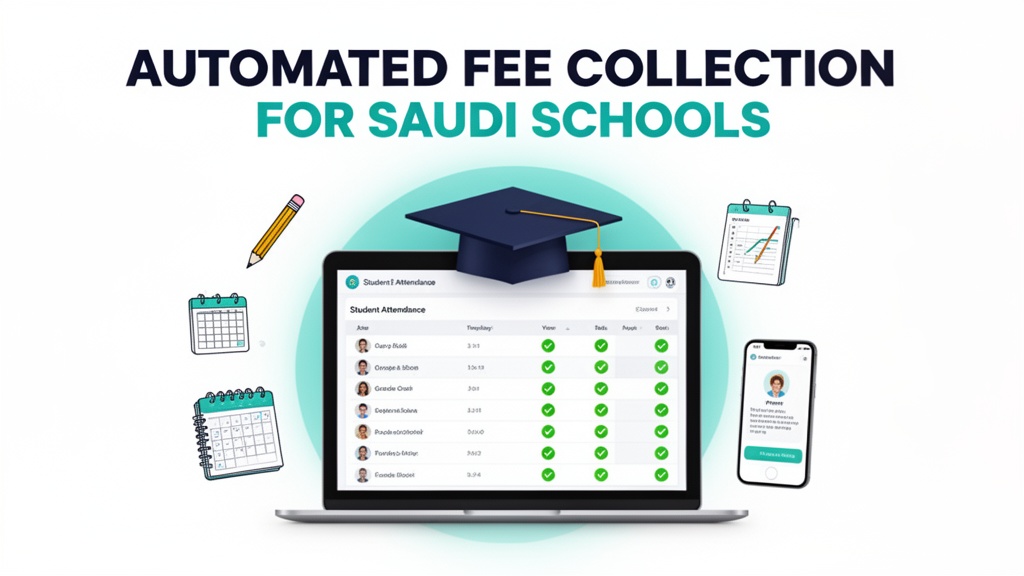
Digital attendance with automated parent SMS/WhatsApp alerts builds trust and transparency. Every morning, teachers mark attendance on the Ubisky app. Parents receive an instant WhatsApp notification: "Fatima was marked present at school today at 7:45 AM." If a student is absent, the message says: "Fatima was marked absent today at 7:45 AM. If you've authorized this absence, please ignore. Otherwise, please contact the school office." This transparency gives parents peace of mind. They know when their child arrives safely. They know about unexplained absences immediately. Schools report fewer disputes about attendance records because parents are notified in real-time. The system also tracks attendance patterns — which students are frequently absent, which classes have attendance issues, and which periods have the most absences. This data helps schools address issues proactively.
Parent portal for progress tracking and communication keeps families engaged in their child's education. Parents log in to see attendance records, exam grades, homework assignments, and teacher comments. They can view fee payment history and download receipts. They can send messages to teachers or the school office directly through the portal. This self-service approach reduces the workload on school staff. Parents aren't calling to ask about grades or attendance — they can check it themselves. They aren't visiting the office to get fee receipts — they download them from the portal. The portal also sends notifications for important updates — exam schedules, holiday announcements, parent-teacher meetings. All communication happens in one place, tracked and accessible. Parents feel more connected to the school. Schools spend less time on routine queries.
Online exam management and grade publishing streamlines assessment. Teachers create exams in the system, set the schedule, and assign subjects. Grades are entered directly — no spreadsheets, no manual calculations, no errors in totaling. The system automatically calculates averages, ranks, and subject-wise performance. When grades are finalized, they're published to the parent portal instantly. Parents receive a WhatsApp notification: "Fatima's mid-term exam results are now available. Log in to view her performance." Teachers can generate detailed performance reports — individual student reports, class-wise analysis, subject-wise trends, and comparison with previous terms. This data-driven approach helps teachers identify students who need extra support and topics that need re-teaching. The entire assessment process, from exam creation to grade publishing, happens digitally. No paper forms, no manual data entry, no delays.
| Stat | Value |
|------|-------|
| Time saved on follow-ups | 22 hrs/week |
| Collection rate increase | 40% |
| Parent preference for WhatsApp | 80% |
Why This Matters in the Saudi Education Context
The Saudi education sector is undergoing rapid digital transformation. The Ministry of Education is promoting smart schools, digital classrooms, and automated administration. Schools that rely on manual processes are falling behind these national initiatives. Parents in Saudi Arabia, especially in cities like Riyadh, Jeddah, and Dammam, have higher expectations now. They're used to mobile banking, digital services, and instant communication. A school that still sends fee reminders by letter and requires parents to visit the office for basic tasks feels outdated.
WhatsApp is deeply embedded in Saudi communication culture. Studies show that 80% of Saudi parents prefer WhatsApp communication over SMS, email, or phone calls. It's the default messaging platform for families. When schools send reminders through WhatsApp, they're meeting parents on their preferred channel. Parents check WhatsApp constantly throughout the day. They don't always check email. They might not answer unknown phone numbers. But they'll read a WhatsApp message. This cultural preference makes WhatsApp reminders significantly more effective than traditional methods. Schools that adapt to this reality see better engagement and faster responses.
Payment methods in Saudi Arabia have also evolved rapidly. Mada, the national payment scheme, is widely accepted online and in-app. Bank transfers are common. Many parents pay digitally — through mobile banking apps, payment platforms like STC Pay, or online portals. When schools offer digital payment options integrated with WhatsApp reminders, the payment process becomes seamless. Parents don't need to visit the school or find time during office hours. They pay from their phone, anytime. This convenience directly translates to higher collection rates. WhatsApp reminders increase fee collection rates by 35-45% within the first month. That's a significant improvement that directly impacts school operations.
How to Implement Automated Fee Collection in Your Saudi School
- Export your student database with parent contacts and fee structures to Excel. Include student names, grade, parent names, phone numbers, and fee amounts.
- Book a 30-minute Ubisky demo and specifically ask to see the fee reminder workflow, payment links, and parent communication features.
- During the demo, test the WhatsApp reminder with your own phone number to experience exactly what parents will receive.
- Start with a pilot for one grade level — send fee reminders to parents of 100 students and track payment response rates for one billing cycle.
- Compare collection timelines, staff time spent on follow-ups, and parent feedback against your previous month's performance.
> Book a free demo — learn how Saudi schools use Ubisky to automate fee collection and boost parent engagement
>
> Join 400+ businesses across GCC, Africa and South Asia already using Ubisky. Free 30-day trial — no credit card required.
>
> Book a Free Demo | Explore School Management System
Frequently Asked Questions
Can Ubisky send fee reminders and attendance alerts in Arabic for Saudi parents?
Yes. Ubisky supports Arabic language templates for all WhatsApp messages including fee reminders, attendance alerts, and exam notifications. You can customize messages in formal Arabic, and the system sends the appropriate language based on parent preference recorded in the database.
Does the system integrate with Saudi payment methods like Mada, STC Pay, and bank transfers?
Yes. Ubisky integrates with popular Saudi payment gateways that accept Mada cards, STC Pay, and online bank transfers. Payment links sent via WhatsApp support multiple payment options so parents can choose their preferred method. Transactions are processed securely and recorded automatically in the system.
How do we migrate student data from our current system or spreadsheets to Ubisky?
Ubisky provides a comprehensive data migration template in Excel format. You export your existing student data, parent contacts, fee structures, and attendance history, then upload it to Ubisky. Technical support assists with mapping data fields and validating the import to ensure no information is lost during transition.
Can parents communicate with teachers directly through the parent portal?
Yes. The parent portal includes a messaging feature where parents can send messages to class teachers, subject teachers, or the school administration. Teachers receive notifications and can respond directly. All communication is recorded and accessible in the student's record, creating a complete history of parent-teacher interactions.
What happens to student data if a student transfers to another school or we switch to another system?
Schools own all student data. When a student transfers, you can export their complete record including attendance, grades, fee payment history, and communications in a standard format. This export can be provided to the new school. If you ever leave Ubisky, you can export all student, parent, and financial data before closing the account.
The Digital Advantage Every Saudi School Needs
Manual fee collection is a drain on school resources. The 22 hours per week spent on follow-ups is time that could be invested in education. Automated WhatsApp reminders eliminate this waste. Parents receive clear, timely reminders with direct payment links. They pay without needing to visit the school or find time during office hours. Collection rates increase by 40% within the first month. That's not an incremental improvement — it's a transformation of how schools manage their finances.
The broader impact on school operations is significant. When fees are collected predictably and on time, schools can plan with confidence. Teachers get the budgets they need for classroom activities. Supplies are purchased on time. Programs aren't delayed. The administrative staff can focus on student support rather than chasing payments. Parents appreciate the transparency — they know exactly what's due, when it's due, and they have the convenience of paying digitally. The WhatsApp notifications keep them informed about their child's attendance, grades, and school updates. Engagement improves. Trust builds.
In the rapidly evolving Saudi education landscape, schools that embrace digital solutions position themselves as modern, efficient, and parent-friendly. Manual processes are becoming a competitive disadvantage. Parents notice which schools use technology to make their lives easier. Students benefit when school resources are directed toward education rather than administration. Explore the School Management System to see how your school can make the digital transition.
See School Management System in Action
Join 400+ businesses across GCC, Africa & South Asia already using Ubisky.
Free 30-day trial — no credit card required.