It's 8:15 AM on Sunday morning in Riyadh. A mother drops her son at school gate and drives to work. She doesn't know whether he reached his classroom on time. In the office, she worries — did he attend? Did he forget his homework? The school sends SMS notifications, but they're expensive, limited to 160 characters, and often delayed. She calls the school reception three times during the week for updates. The receptionist is busy with other calls. Frustration builds on both sides. Every school administrator in Saudi Arabia knows this scenario — parents want information, and the school wants to provide it, but the communication gap remains.
The Real Cost of Outdated Communication Systems
Schools in Saudi Arabia spend massive amounts on SMS alerts for attendance, exam results, fee reminders, and announcements. Each message costs money. A school with 2,000 students sending daily attendance alerts can spend SAR 8,000-12,000 per month. The bigger problem is engagement — SMS messages have 20-30% open rates, and many parents miss critical information. Parents call the school constantly: "Was my child present today?" "When are exam results out?" "Is there a parent-teacher meeting tomorrow?" The front office becomes a call center instead of focusing on students. Schools using WhatsApp parent portals see 60-75% higher parent engagement rates compared to SMS-only systems. The cost difference is staggering: WhatsApp messages cost 80-90% less than SMS for school communication in Saudi Arabia.
How the School Management System Transforms Parent Communication
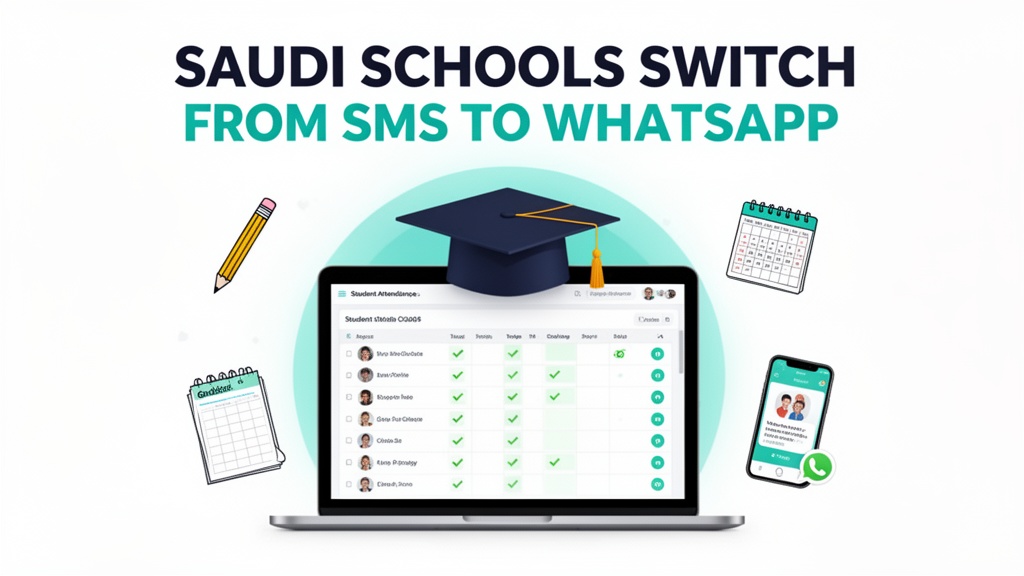
The Ubisky School Management System replaces SMS with a WhatsApp-integrated parent portal. When a student's attendance is marked in the classroom — present, absent, or late — the system automatically sends a WhatsApp notification to the parent within seconds. The message isn't just a generic "your child was marked present" — it's personalized with the student's name, class section, and time. When exam results are published, parents receive a WhatsApp message with a direct link to view grades. If a fee is overdue, a polite reminder arrives with payment options. The parent portal itself is a WhatsApp Business account where parents can ask questions, check attendance history, review grades, and even communicate with teachers — all through the app they already use daily.
Key Features That Connect Parents to Schools
The Digital attendance with automated parent SMS/WhatsApp alerts feature provides instant peace of mind. When a teacher marks attendance on their tablet, the system immediately checks against the parent's preferred notification method. For most parents in Saudi Arabia, that's WhatsApp. The notification arrives as a WhatsApp message: "Assalamu alaikum, Ahmed Mohammed was marked PRESENT today at 7:55 AM in Grade 5-A." If a student is absent, the message is urgent: "Your daughter Fatima was marked ABSENT today. Please call the school office to confirm if this is expected." Real-time attendance notifications via WhatsApp reduce parent inquiries by 40-50% in Saudi private schools because parents already know the answer before they even think to call.
Online exam management and grade publishing makes result distribution seamless. Teachers enter grades into the system, and when results are officially published, parents get a WhatsApp notification: "Mid-term exam results for Grade 8-B are now available. Click here to view [link]." The parent clicks, enters their registered phone number for verification, and sees the full report card — subject-wise marks, class rank, teacher comments, and attendance percentage. No paper report cards lost in backpacks, no waiting for scheduled pickup dates. The system also generates performance trends over time, showing parents whether their child is improving, declining, or staying stable across subjects.
The Parent portal for progress tracking and communication feature turns WhatsApp into a two-way communication channel. Parents can send messages: "How is my son doing in mathematics this month?" The system routes the query to the math teacher, who responds through the same interface. Attendance graphs show patterns: this student missed 3 days in March, but 0 days in April. Behavior notes from teachers appear as timestamped entries. Fee due dates, upcoming exams, and school announcements all flow through the portal. The parent has a complete picture of their child's school experience without ever needing to visit in person.
Transport tracking and safety alerts address parents' biggest worry: the school bus ride. When a student boards the bus in the morning, the parent gets a WhatsApp notification: "Your daughter boarded Bus #12 at 6:45 AM. Expected arrival at home pickup point: 7:15 AM." GPS tracking on the parent portal shows real-time bus location. If the bus is delayed due to traffic, another notification explains the delay and revised ETA. When the student arrives at the bus stop and disembarks, the parent receives confirmation: "Your son has arrived at home pickup point." For working parents who cannot be at the stop, this visibility is invaluable.
| Stat | Value |
|------|-------|
| Cost savings vs SMS | 85% |
| Higher parent engagement | 70% |
| Fewer parent inquiries | 45% |
Local Market Context: Saudi Arabia
Saudi Arabia's education sector is undergoing rapid modernization under Vision 2030. Parents expect digital communication, real-time updates, and transparency. International schools in Riyadh, Jeddah, and Dammam compete on technology adoption — parents compare which schools offer parent portals, instant notifications, and digital access. Schools that fail to modernize communication lose enrollment to those that do. The Ministry of Education increasingly expects schools to demonstrate effective parent engagement, and WhatsApp portals provide measurable data: open rates, response times, and interaction frequency.
WhatsApp usage in Saudi Arabia is among the highest in the world — over 95% of smartphone users rely on it daily. It's the default communication app for families, businesses, and yes, schools. Parents are already checking WhatsApp constantly throughout the day. When school notifications arrive there, they're seen and read immediately. SMS, by contrast, is viewed as outdated by many Saudi parents. Younger parents may not even read SMS messages, assuming they're spam or marketing calls.
Cultural dynamics make parent communication especially sensitive in Saudi schools. Parents — particularly mothers — want to stay closely involved in their children's education. Many work full-time and cannot visit the school frequently. Others are expatriates living in different countries, managing their children's education remotely. For these parents, the WhatsApp portal is a lifeline. They see attendance daily, grades immediately, and can communicate with teachers without visiting the school gate. Working mothers report feeling more connected to their children's school experience when they receive regular, detailed updates through WhatsApp.
Ramadan presents a special challenge for Saudi schools. School hours change, exam schedules shift, and communication needs increase. Parents need to know about timing changes, iftar arrangements, and exam dates. During Ramadan, communication volume spikes, and the cost difference between SMS and WhatsApp becomes obvious. A school that sends 10 SMS messages per student during Ramadan for 2,000 students would spend SAR 5,000-6,000 just for that month. WhatsApp costs a fraction of that amount for far more messages — including rich media like PDFs, images, and links.
How to Get Started
- Collect current parent phone numbers and verify WhatsApp enrollment by sending a test message
- Configure notification preferences for each parent: attendance, exams, fees, transport, and announcements
- Train administrative staff and teachers on the system during a 2-day workshop with hands-on practice
- Run a 2-week pilot with one grade section, measuring parent response rates and office call reduction
- After successful pilot, roll out to the entire school and measure cost savings compared to previous SMS spend
> Request a demo — see how Saudi schools use Ubisky to connect with parents through WhatsApp
>
> Join 400+ businesses across GCC, Africa and South Asia already using Ubisky. Free 30-day trial — no credit card required.
>
> Book a Free Demo | Explore School Management System
Frequently Asked Questions
Can parents receive messages in both Arabic and English?
Yes. Each parent can set their language preference, and the system sends WhatsApp messages in their chosen language. The parent portal also supports both Arabic and English interfaces, with automatic switching based on the parent's selection.
What if a parent doesn't have WhatsApp or prefers SMS notifications?
The system supports SMS as a fallback for parents who don't use WhatsApp. When a parent's phone number is registered, the system automatically detects whether it's connected to WhatsApp Business API and sends the appropriate notification method.
How do we ensure student privacy with WhatsApp messaging?
Privacy is built-in. Parents only receive information about their own children. Access to the parent portal requires two-factor verification: the registered phone number plus a one-time PIN sent to that same number. Teachers cannot see other students' data when responding to parent queries.
Can we send video messages or voice notes to parents through WhatsApp?
Yes. Rich media is fully supported. Schools can send video announcements, voice notes from principals, images of exam schedules, PDF report cards, and even short instructional clips. WhatsApp's message quality and speed make it ideal for multimedia communication.
What happens during system downtime or WhatsApp service outages?
The system has redundancy measures. If WhatsApp experiences temporary downtime, messages queue automatically and deliver when service is restored. Critical alerts like attendance and transport safety have SMS backup as a fail-safe for maximum reliability.
Saudi schools that switch from SMS to the Ubisky School Management System report dramatic improvements in parent engagement and significant cost savings. The office staff spends less time answering the phone and more time supporting students. Parents feel more connected and involved because they receive regular, detailed information through an app they already use. The school saves thousands of riyals monthly that can be redirected to educational resources, teacher development, or facility improvements. Most importantly, the communication gap between home and school narrows, creating a partnership that benefits students.
Explore the School Management System
See School Management System in Action
Join 400+ businesses across GCC, Africa & South Asia already using Ubisky.
Free 30-day trial — no credit card required.