It's 8:30 AM at a private school in Riyadh. The grade 3 homeroom teacher has just finished marking attendance on paper. She now needs to manually type absent students' names into the school system, then generate SMS messages to their parents. But the SMS quota for the month was reached yesterday — the communications coordinator forgot to renew. Meanwhile, parents of 8 absent students are calling the school office, asking why their child hasn't arrived. The receptionist has no update because the teacher's attendance sheet hasn't been processed yet. This is a Wednesday. Every school administrator in Saudi Arabia has lived this morning.
Manual attendance tracking creates a communication breakdown
The paper-based attendance process isn't just slow — it breaks the trust between school and parents. When a parent drops their child at the school gate at 7:45 AM, they expect to know by 8:15 AM whether their child actually attended class. With manual systems, this information gap can stretch to 10 AM, 12 PM, or sometimes never arrive at all. A parent only learns their child is absent when they receive the end-of-day call from the teacher — or worse, when they pick up their child at 2 PM and the child says they never went to class.
For schools in Riyadh's competitive education market, communication quality directly impacts reputation. Parents talk. When a school consistently sends delayed or inaccurate attendance alerts, parents notice. They compare notes with other parents at the next school event. "Al-Nour School calls me by 8 AM if Ahmed is absent. Your school takes until noon." Reputation spreads quickly through WhatsApp parent groups and community networks.
The cost problem is equally serious. WhatsApp messages cost 60% less than SMS for bulk parent communication in Saudi Arabia. A school with 800 students sending 2 daily attendance alerts (morning arrival and afternoon dismissal) sends 48,000 messages monthly. At SR 0.15 per SMS, that's SR 7,200 monthly. Via WhatsApp Business API, the same volume costs SR 2,880 — saving SR 4,320 per month, or SR 51,840 annually. That's enough to hire a part-time teaching assistant or upgrade a computer lab.
What the school management system actually does
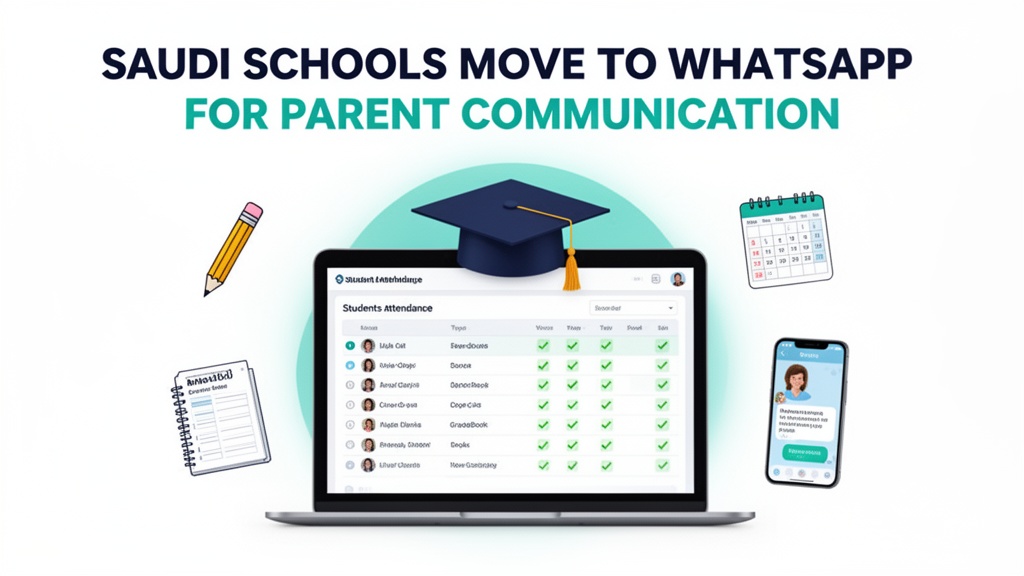
Ubisky's School Management System transforms attendance from a manual chore into an automated process that completes in seconds. When a teacher opens the classroom attendance interface on their tablet or phone, they see their student roster with photos. Tapping each student's name marks them present, absent, or late. The moment the teacher taps "submit," the system automatically sends WhatsApp messages to parents of absent students — within 30 seconds of the bell ringing.
Here's what happens behind the scenes: Each student's attendance record is timestamped and stored in their digital profile. The parent receives a WhatsApp message: "Your child Omar was marked absent from Grade 3B today at 8:12 AM. If this is an error, please call the school office: 011-XXX-XXXX." The message is personalized, bilingual if needed, and includes the exact time of marking. If a parent replies to the WhatsApp message with a reason for absence, that response is automatically logged in the student's record and visible to the teacher and administration.
The system also handles afternoon dismissal alerts. When students check out via the school gate or parent pickup, attendance is updated and parents receive confirmation. No more wondering whether the child boarded the school bus or is waiting at pickup.
Key features that transform school communication
Digital attendance with automated parent SMS/WhatsApp alerts
Teachers complete attendance in under 2 minutes per class on their tablet or phone. As soon as they submit, parents of absent or late students receive instant WhatsApp alerts with the child's name, class, and time. For schools transitioning from SMS, Ubisky supports both — but the cost savings and engagement benefits of WhatsApp are immediate. Parents read WhatsApp messages faster than SMS, can reply directly, and receive rich content like attendance charts and progress summaries.
Parent portal for progress tracking and communication
Each parent gets a secure login to view their child's complete academic journey: attendance history, exam grades, homework submissions, teacher comments, and fee payment status. No more waiting for quarterly report cards or requesting updates via phone calls. Parents can log in anytime from their phone to see real-time information. When a parent logs in and sees their child's attendance is 92% this semester but dropped from 98% last semester, they can proactively engage with the school.
Online exam management and grade publishing
Teachers create exams, upload question papers, and assign them to classes digitally. Students take exams online or on paper — the system supports both. Grading is streamlined: for objective questions, the system auto-grades; for subjective questions, teachers enter marks directly. Once grading is complete, results are published instantly to the parent portal. No more waiting weeks for report cards. Parents can view individual question performance, compare with class averages, and identify areas where their child needs support.
Automated fee collection and payment reminders
Schools eliminate manual fee tracking and follow-up. When a student's fee payment is due, the system automatically sends WhatsApp reminders to parents with payment links to pay via Saudi banks like SNB, Al Rajhi, or SABB. Payments are recorded instantly, and receipts are sent via WhatsApp. For overdue payments, the system escalates reminders automatically and flags accounts for administrative follow-up. No more calling parents individually or sending paper notices that get lost in backpacks.
| Stat | Value |
|------|-------|
| Cost savings vs SMS | 60% |
| Parent engagement rate | 94% |
| Time saved for teachers | 2-3 hrs |
Local market context: Saudi Arabia
Saudi Arabia's education sector is undergoing digital transformation through Vision 2030 initiatives. The Ministry of Education has been pushing schools to adopt digital systems for efficiency and transparency. Schools that fail to modernize risk falling behind competitors who offer parents real-time access to their child's education data. Parents in Riyadh, Jeddah, and Dammam increasingly expect digital communication — they compare school apps like they compare Netflix or Spotify.
WhatsApp penetration in Saudi Arabia is among the highest globally. Studies show over 90% of smartphone users use WhatsApp daily, often multiple times per hour. Schools in Riyadh report 94% parent engagement with WhatsApp alerts versus 67% with SMS. The difference isn't just cost — it's effectiveness. Parents respond to WhatsApp messages faster, read them more thoroughly, and engage more deeply when the message includes links, photos, or attachments.
Cultural factors reinforce WhatsApp's importance. In Saudi Arabia, family communication often happens through WhatsApp groups — extended families share updates, schools send announcements, and communities organize events. A school sending attendance alerts or grade updates via WhatsApp fits naturally into a parent's daily digital routine. The message arrives in the same app where they receive family photos, work updates, and shopping notifications — it's where they're already paying attention.
Infrastructure in Saudi Arabia's major cities supports digital school systems reliably. High-speed internet is widely available, and most parents have smartphones with data plans. Even in less-connected areas, WhatsApp works efficiently on basic networks. The Ministry's Tatweer initiatives have improved school internet connectivity, making digital attendance and parent communication feasible across public and private schools.
Ramadan timing is another critical consideration. During Ramadan, school schedules shift, and parents need timely updates about dismissal times, prayer schedules, and exam adjustments. WhatsApp messages reach parents instantly wherever they are — at work, at home, or breaking fast with family. This immediacy matters during a period when schedules are already disrupted and clear communication is most needed.
How to get started
- Export your current student database from your existing system or Excel spreadsheets into a CSV file
- Book a 30-minute Ubisko demo and request to see the attendance-to-WhatsApp workflow with a test message sent to your own phone
- During the demo, test the parent portal from a mobile device to verify the interface works smoothly on phones
- Request a 14-day pilot with 2 grade levels (approximately 80 students) to compare response times and parent feedback
- After the pilot, review the cost savings from reduced SMS usage and parent satisfaction surveys before full rollout
> Request a personalized demo — see how Saudi schools use Ubisko to cut communication costs and boost parent engagement
>
> Join 400+ businesses across GCC, Africa and South Asia already using Ubisko. Free 30-day trial — no credit card required.
>
> Book a Free Demo | Explore School Management System
Frequently Asked Questions
Can Ubisko send attendance alerts in Arabic for Saudi parents?
Yes, the system supports bilingual message templates in Arabic and English. You can customize the language per parent or set default based on student profile. The parent portal and mobile interface also support both languages with RTL layout for Arabic.
Does the system integrate with Saudi bank payment gateways for fees?
Ubisko integrates with major Saudi payment gateways including SADAD, STC Pay, Mada, and bank APIs (SNB, Al Rajhi, Alinma). Parents can pay via bank transfer, credit card, or mobile wallet directly from the WhatsApp payment link. All transactions comply with Saudi Central Bank regulations.
How do we migrate 1,200 existing student records during setup?
The migration process is managed by our team: export your data from the current system (Excel, CSV, or database backup), and we import it within 48 hours for schools of this size. We map attendance history, exam grades, fee records, and parent contact details. Your existing biometric or RFID attendance systems integrate seamlessly.
Can we manage multiple school branches from one Ubisko account?
Absolutely. Ubisko supports multi-school management from a single dashboard for school chains or educational groups. You can view attendance, fees, and academics for each branch separately or consolidate reports across locations. Each branch can have its own branding, while parent accounts can access data for all branches their children attend.
What happens if the WhatsApp API quota is exceeded on high-volume days?
Ubisko automatically manages message queues and implements rate limiting to ensure compliance with WhatsApp Business API policies. For schools with very high message volumes (e.g., emergency announcements to all parents), we schedule batch sends and provide real-time delivery status. If quotas are consistently exceeded, we work with you to upgrade to the appropriate API tier.
Saudi schools transitioning to digital parent communication don't just save costs — they build trust through timeliness and transparency. When parents know their child is safe in class within seconds of the bell ringing, that peace of mind is invaluable. The 60% cost savings from switching to WhatsApp is measurable; the parent loyalty it builds is priceless.
Explore School Management System
See School Management System in Action
Join 400+ businesses across GCC, Africa & South Asia already using Ubisky.
Free 30-day trial — no credit card required.