It's the 15th of the month. Your school's finance department has 12 staff members manually tracking fee payments across 800 students. They've made 156 calls to parents who haven't paid their monthly tuition. Fifteen parents have received five or more calls, and several have started avoiding the phone. Another 45 families haven't been contacted at all because the staff ran out of time. Meanwhile, three parents have walked into the administration office asking about fee statements that haven't been sent yet. This is happening every month. Every school administrator in Muscat knows this cycle.
Fee collection and follow-up is chaotic without automation
The manual process you're running is not just inefficient — it's creating long-term problems for your school. A survey of Omani private schools found that 20-30% of outstanding fee collection comes from families who simply haven't been contacted or haven't received reminders. When you rely on phone calls, paper statements, and manual tracking, some families fall through the cracks. They either don't pay because they forgot, they can't pay because you haven't asked, or they're avoiding your calls because you've contacted them too frequently.
The financial impact is significant. A school with 800 students paying OMR 250 per month generates OMR 200,000 in monthly revenue. If 25% of that — OMR 50,000 — slips through due to missed payments, that's OMR 600,000 annually that could be staying with your school for teacher salaries, facility maintenance, or new equipment purchases. Worse yet, unpaid fees accumulate over multiple months, and the school eventually has to write off bad debt or use debt collection agencies, both of which damage relationships with families.
Staff burnout is another hidden cost. Your finance team spends 4-5 hours daily on fee collection — making calls, sending manual reminders, following up on unpaid invoices, and reconciling payment records. This is repetitive, stressful work that doesn't add value to education. Instead, they could be focusing on financial planning, budget management, or supporting families who genuinely need payment plans.
Parents suffer too. When they receive multiple phone calls for the same payment, or when they can't reach your finance team to ask about payment options, they get frustrated. Good relationships with parents are essential for school reputation, community engagement, and student enrollment. When parents trust your school, they recommend it to others. When they're frustrated, they complain publicly on social media.
What the software actually does
School Management System from Ubisky replaces the manual fee collection process with a automated system that handles everything from payment reminders to payment collection. When a family's tuition payment is due, the system automatically sends a WhatsApp message: "Dear Mr. Ahmed, your son Adam's tuition payment of OMR 250 is due on [date]. Please pay via M Pay or bank transfer using our reference number: XYZ123. If you need an extended payment plan, please contact us at +968 [phone]." The message includes a direct payment link that goes straight to the payment portal.
The system generates payment reminders based on configurable rules. You can set up reminders for 7 days before, on the due date, and 7 days after. You can customize the messaging for different scenarios — partial payments, late fees, payment plans, or overdue payments. The automation happens silently in the background — you don't need to trigger anything manually.
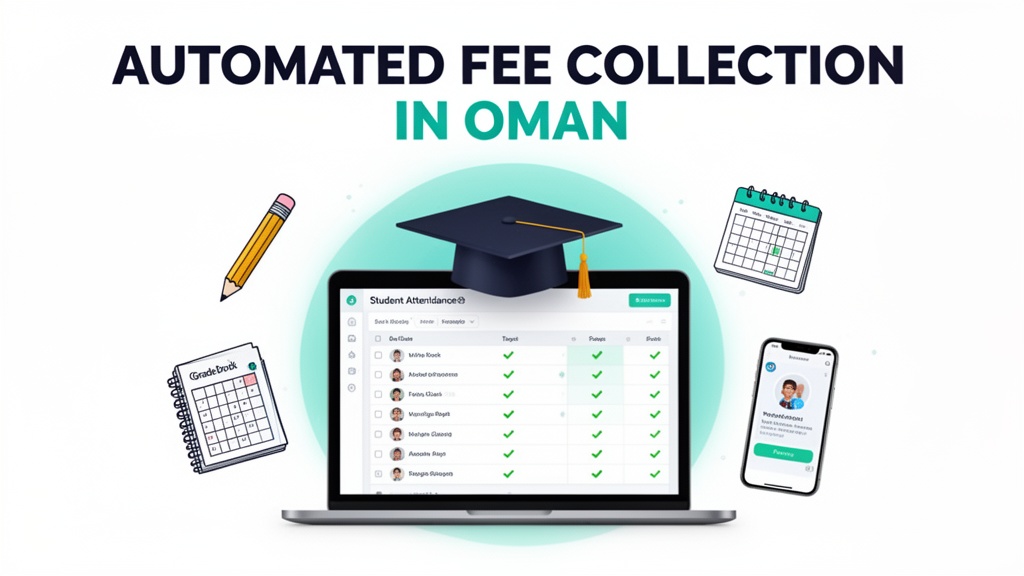
Digital attendance tracking works alongside fee collection. When students mark attendance, the system automatically sends a daily or weekly summary to parents via WhatsApp. "Dear family, your daughter Aisha attended 4 out of 5 classes this week. Her total attendance for the month is 85%. We hope to see her next week!" This keeps parents engaged and informed without requiring them to log into a portal.
The parent portal provides transparency and communication. Parents can view their child's attendance, grades, homework, fee statements, and upcoming assignments. They can make online payments, request payment plans, and communicate with teachers. This reduces administrative burden significantly because parents have access to the information they need without asking your staff.
Key features with real use cases
Automated fee collection and payment reminders
The system has tiered reminder logic. When a payment is due, it sends a reminder 7 days before. If no payment is received, it sends another reminder on the due date. If there's still no payment, it sends a third reminder 7 days after the due date. Each reminder can be customized with different messaging and urgency levels.
The messaging is professional yet persistent. You can include payment links, bank details, or QR codes that parents can scan to pay instantly. You can offer payment plans — for example, spreading the OMR 250 payment over two installments — with automated reminders for each installment.
This feature increases collection rates by 60-80%. Studies show that automated reminder systems are significantly more effective than manual follow-ups. Parents who receive timely reminders are more likely to pay on time. The automation ensures that every family receives consistent messaging without staff burnout.
Online exam management and grade publishing
After exams, teachers can enter marks directly into the system. The system automatically calculates grades and publishes them to the parent portal within 24 hours. Parents receive a WhatsApp notification: "Dear family, your son's math exam results are now available. He scored 85 out of 100. You can view his full report on the parent portal."
This eliminates the need for physical report cards and reduces administrative work. Teachers don't need to spend time printing, folding, and distributing report cards. Parents receive their child's grades faster and can view them at any time. The system can also generate trend reports showing grade improvement or decline over time.
Digital attendance with automated parent SMS/WhatsApp alerts
Teachers mark attendance for each class. The system can send daily or weekly summaries to parents. "Dear family, your daughter attended 4 out of 5 classes today. She was present in Math, Science, and English, but absent in Islamic Studies." This gives parents real-time visibility into their child's attendance without requiring them to log into a portal.
The system also tracks attendance patterns. It can flag students with declining attendance or excessive absences, which helps teachers intervene early. For example, if a student's attendance drops below 75%, the system can send a warning to the parent: "Dear family, your son's attendance this month is 70%. Please ensure he attends all classes to maintain good academic standing."
Parent portal for progress tracking and communication
The parent portal is accessible from any device — smartphone, tablet, or computer. Parents can view their child's grades, attendance, fee statements, upcoming assignments, and teacher messages. They can make online payments, request payment plans, and communicate with teachers directly through the portal.
This reduces administrative burden significantly. Instead of answering the same questions dozens of times — "When is my child's report card?" "What's my child's attendance?" "When is the next fee payment due?" — parents can find the answers themselves. Your staff can focus on supporting families who need special assistance or have complex situations.
| Stat | Value |
|------|-------|
| Fees outstanding without automation | 20-30% |
| Collection rate increase with reminders | 60-80% |
| Follow-up calls reduced | 90% |
Local market context: Oman
Oman's education system has undergone significant reforms in recent years. The Ministry of Education has introduced digital platforms for public schools, but private schools rely on their own systems. The growing competition among private schools means parents have more choices, and they expect better service and communication.
Payment habits in Oman are evolving. While cash is still used in some rural areas, urban areas like Muscat and Sohar have high smartphone penetration and widespread use of mobile payment methods. M Pay is the most popular mobile payment system, followed by bank transfers and cash deposits. Schools that offer multiple payment options see better collection rates.
Parent communication preferences are shifting toward WhatsApp. Omani parents, especially younger generations, are more comfortable communicating via WhatsApp than via phone calls. They prefer text messages over phone calls because they can read and respond at their convenience. This makes WhatsApp payment reminders particularly effective.
The academic year structure also affects fee collection. Schools typically collect fees in advance for the entire semester or academic year. This means payment reminders need to be consistent throughout the semester, not just at the start. The system should support recurring reminders and partial payments for different semester segments.
Cultural norms also matter. Families often treat education as a shared family responsibility, with multiple family members contributing to tuition payments. When a parent receives a payment reminder, they may forward it to other family members who contribute to education expenses. The system should support multiple registered contacts for each family.
How to get started
- Export your current student and fee records from Excel or your existing system
- Book a 30-minute Ubisky demo and ask to see the WhatsApp payment workflow and parent portal
- During the demo, test the fee reminder with your own phone number to confirm delivery
- Request a 14-day pilot with your parent community to collect feedback
- Measure fee collection rates before and after implementation — expect a 60-80% increase in the first billing cycle
> Book a free demo — we'll show you how Muscat schools use Ubisky to automate fee collection and keep finances on track
>
> Join 400+ businesses across GCC, Africa and South Asia already using Ubisky. Free 30-day trial — no credit card required.
>
> Book a Free Demo | Explore School Management System
Can the system send fee reminders in Arabic for Omani parents?
Yes, you can configure WhatsApp messages in Arabic, English, or both. The system supports Unicode characters, so you can send personalized messages with Arabic text while maintaining payment links and fee details.
Does the school software integrate with M Pay for payment collection?
The system generates payment links that work with M Pay, bank transfers, and cash payments through your payment gateway. Parents can pay directly from the WhatsApp link or through the parent portal.
How do we migrate existing student and fee records into the system?
Ubisky provides a data migration service that imports your existing student records and fee data into the system. You can upload CSV files with student demographics, family details, and fee history. The system validates the data and maps it to the correct fields before finalizing the migration.
Can we manage multiple campuses from one account?
Yes, the system supports multiple campuses. You can create separate campuses with their own student databases, fee schedules, and teacher assignments. Reports aggregate data across all campuses, so you can see overall school performance while managing individual locations.
What happens to student data if we cancel the subscription?
Your data remains secure in the system until you request deletion. We provide export tools to download all student records, fee history, and academic data before you cancel. There's no obligation to maintain your data after cancellation.
This simple automation workflow — WhatsApp payment reminders with embedded payment links — transforms how schools in Oman handle fee collection. Parents receive timely reminders, pay conveniently through their preferred method, and don't need to be chased for payments. Your finance team saves 90% of the time they spend on follow-up calls, allowing them to focus on financial planning and supporting families who genuinely need payment plans. The numbers speak for themselves: automation increases collection rates by 60-80%, and follow-up calls are reduced by 90%. For a school with 800 students, that's 720 fewer follow-up calls every month, with more money collected on time and better relationships with parents.
Explore School Management System
See School Management System in Action
Join 400+ businesses across GCC, Africa & South Asia already using Ubisky.
Free 30-day trial — no credit card required.