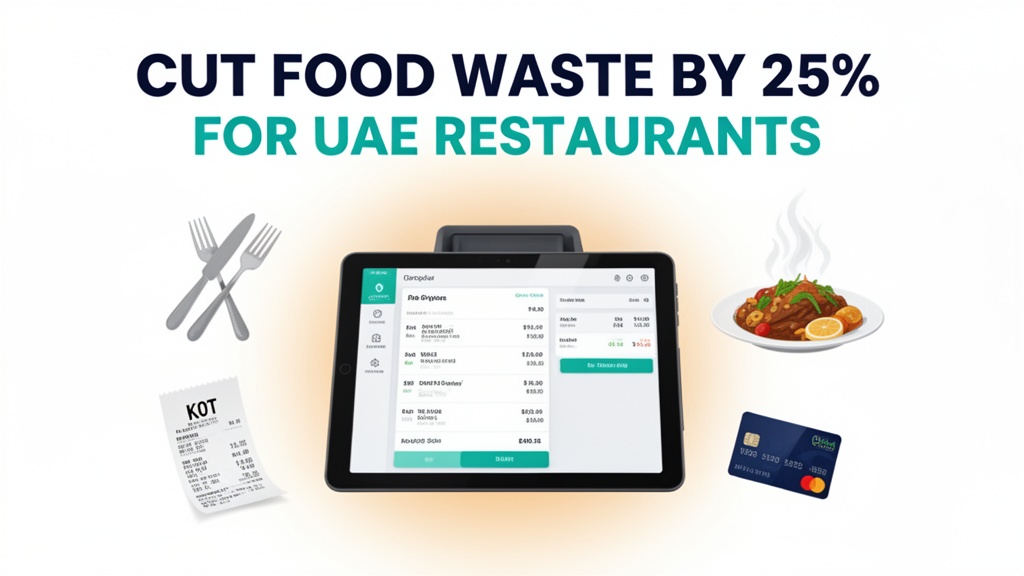
It's Monday morning at your restaurant in JLT. Your chef is in the walk-in freezer checking stock. He pulls out two cartons of imported beef — both expired on Sunday. Next to them, five kilos of fresh herbs are turning yellow. Out front, your inventory sheet from Friday shows these items as "in stock." The reality: they were never used, never reordered, and now they're waste. This isn't just food — it's money. Those two cartons cost AED 400. The herbs were AED 80. You threw away AED 480 this morning alone. Every restaurant owner in UAE knows this feeling.
The Silent Margin Killer: Inventory Waste
Restaurants in UAE lose 8-12% of their food costs to waste and spoilage annually. For a restaurant doing AED 100,000 in monthly food sales, that's AED 8,000-12,000 gone — AED 96,000-144,000 per year. This isn't about diners not finishing their plates. This is inventory you bought, stored, and never used. Fresh produce that rots. Dairy that expires. Bulk purchases that don't match actual consumption.
The problem isn't waste awareness — every chef knows they're throwing away food. The problem is visibility. Your inventory sheet is a snapshot from last week. Your POS system shows what was sold. But nobody connects these two in real time. The kitchen doesn't know what's about to expire. The manager doesn't know what's overstocked. Reordering happens based on guesswork, not data.
Automated inventory tracking reduces food waste by 20-30% within the first 3 months. Real-time stock monitoring reduces over-ordering by 35-40%. The math is simple: see what you have, see what you use, order what you need.
What Ubisky Restaurant POS Actually Does
Ubisky is restaurant management software that connects your orders, kitchen, and inventory in real time. When a waiter takes an order for "Grilled Salmon with Asparagus," the system immediately logs it: salmon fillet deducted, asparagus spears deducted, sides deducted. As each item is deducted, inventory levels update instantly across all devices.
When asparagus drops to 5 kg remaining, the system triggers a low-stock alert: "Asparagus running low — 5 kg left. Recommend reorder: 10 kg." The kitchen display shows this alert. Your manager receives a notification. The chef confirms actual usage. Reordering happens before stock runs out — not after.
Every sale updates inventory. Every waste entry is logged. Every expiry date is tracked. Your inventory sheet isn't a weekly task anymore — it's a live dashboard you check anytime.
Key Features That Reduce Waste
Automated inventory tracking and low-stock alerts monitors every ingredient in real time. When an order is placed, inventory deducts automatically. When stock hits your minimum threshold, alerts fire. Your team gets notified via WhatsApp or in-app: "Olive oil at 4 liters — reorder now." Expiry tracking is built in — items expiring in 3 days are flagged for immediate use. Your chef sees: "Use these tomatoes before Friday." Waste isn't inevitable anymore.
Digital order taking with kitchen display system eliminates order errors that lead to waste. A waiter accidentally orders the wrong side — kitchen receives the digital order, asks to confirm via KDS, the correction happens before food is cooked. No remakes, no wasted plates. The kitchen display shows all orders in priority sequence — items are cooked in the right order, nothing sits too long, nothing gets overcooked. The system tracks prep times: your average risotto takes 18 minutes from order to plate. When it takes 25, something's wrong. You catch it, you fix it.
Daily sales and margin analytics reveals waste patterns you can't see manually. The dashboard shows cost of goods sold (COGS) per dish. Margins that should be 70% are actually 55% — why? Dig in: your grilled chicken is 100g per portion, but staff is serving 120g. That's 20% extra cost per plate. Your hummus recipe calls for tahini, but staff uses more for flavor. Small leaks add up to big margins. You see them, you fix them, profits go up.
Fast billing with multiple payment options speeds up operations, reducing errors that cause waste. When servers spend less time on manual billing, they have more time for accurate order taking. Bills are accurate, kitchens receive precise orders, and fewer dishes are returned for mistakes. Payments happen in seconds via card, Apple Pay, or UAE-issued cards. Tables turn faster. Service improves. Less food goes cold and gets sent back.
| Stat | Value |
|------|-------|
| Annual food cost loss to waste | 8-12% |
| Waste reduction with automation | 20-30% |
| Over-ordering reduction | 35-40% |
Local Market Context: UAE
UAE's restaurant market operates on thin margins. Dubai alone has over 12,000 restaurants. Competition is fierce. Every dirham of waste is a dirham of profit lost. Rent, labor, and utility costs are high in UAE cities — you can't afford to throw away food that you paid for.
Import dependency shapes inventory reality. Most ingredients are imported — beef from Australia, vegetables from Holland, specialty items from various countries. Lead times are 3-7 days. When you're out of stock, you're waiting a week. When you over-order, imports are hard to return. This forces many restaurants to stockpile "just in case" — which leads to expiry and waste. Ubisky's predictive ordering helps: the system learns your consumption patterns and recommends orders that match actual demand, not guesswork.
Payment methods in UAE are card-dominant, especially in Dubai. Cash is declining. Your POS needs to handle cards, Apple Pay, and local UAE-issued debit/credit cards seamlessly. Ubisky integrates with local payment gateways — payments process in seconds, receipts are digital, and tipping options are built in. Faster payments mean faster table turnover, less food sitting out, and fewer orders getting cold.
Seasonality affects inventory significantly. Ramadan changes everything — daytime dining disappears, night-time demand peaks. Summer months see fewer tourists. Expo periods and Dubai Shopping Festival bring crowds. Without tracking, you either over-order during slow months (waste) or under-order during peak seasons (lost sales). Ubisky's sales analytics show you seasonal patterns: "Last year, chicken orders increased 40% during Ramadan. Recommend: increase stock by 35%." Your ordering becomes predictive, not reactive.
Labor regulations matter too. UAE has specific rules on working hours, especially for outdoor kitchens during summer. Your inventory system needs to account for reduced prep capacity during heat months. Ubisko tracks staff hours and adjusts prep recommendations: "With 3 kitchen staff this week, prep capacity is 80% of normal. Adjust ordering accordingly." You don't order food you can't prep.
Supplier relationships vary. Some deliver daily, some weekly. Some accept returns, some don't. Ubisko tracks supplier delivery schedules and return policies. When you order from a supplier with a 3-day lead time, the system factors that in. When stock is low and a supplier doesn't accept returns, the system alerts you to order carefully. Supplier performance is tracked too — who delivers late, who sends incorrect quantities. You make better sourcing decisions over time.
How to Get Started
- Export your current inventory list with supplier details and reorder points
- Book a 30-minute Ubisko demo focused on restaurant inventory management in UAE
- Request a 14-day pilot tracking 5-10 key ingredients to see real-time deduction and low-stock alerts
- Compare your manual inventory costs from last month to tracked waste in the pilot period
- Train your kitchen staff on the app — they'll see live stock levels on their phones during prep
> Book a free demo — we'll show you how UAE restaurants use Ubisky to cut waste and boost margins
>
> Join 400+ businesses across GCC, Africa and South Asia already using Ubisky. Free 30-day trial — no credit card required.
>
> Book a Free Demo | Explore Restaurant POS System
Frequently Asked Questions
Does the restaurant POS integrate with local UAE payment gateways and card terminals?
Yes. Ubisko integrates with major UAE payment processors including Network International, Telr, and Mashreq Pay. We support card terminals from local banks and fintech providers. Apple Pay and Samsung Pay are built in. When a customer pays via card, the transaction processes in 2-3 seconds, and inventory updates instantly. No manual reconciliation between card machine and POS — everything syncs automatically.
How does the system handle imported ingredients with long lead times and minimum order quantities?
Ubisko tracks supplier profiles individually: lead time, minimum order quantity, return policy, and delivery schedule. When you reorder imported items, the system calculates based on consumption rate plus lead time buffer. For minimum order quantities, it shows you the cost implications: "Reordering 100kg exceeds immediate needs by 20kg. Estimated storage cost: AED 50/month. Proceed?" You make informed decisions about when to over-order versus wait for smaller shipments.
Can we track inventory across multiple restaurant locations from one central account?
Absolutely. Ubisko supports multi-location restaurant chains with centralized inventory management. Each location has its own inventory tracked separately, but you view stock levels across all locations from the head office dashboard. When Location A has excess stock of an item and Location B is low, the system flags a transfer opportunity. You can move inventory between locations to reduce waste and optimize cash flow. All transfer requests and approvals happen in-app.
How do we handle ingredient waste tracking for compliance with UAE food safety regulations?
Waste logging is built into the system. When staff discard expired or spoiled items, they select the ingredient, quantity, and reason (expiry, spoilage, prep error). The system timestamps every waste entry and generates waste reports for food safety inspections. These reports show total waste by category, which helps you identify problem areas. The audit trail proves compliance with UAE municipality food safety requirements during inspections.
Can the inventory system handle recipes with complex ingredient sub-assemblies?
Yes. Ubisko supports nested recipes and sub-assemblies. For example, "Beef Burger" has ingredients: beef patty, burger bun, sauce. The sauce itself is a recipe with sub-ingredients: mayonnaise, ketchup, spices, mustard. When a burger is ordered, the system deducts the finished items (patty, bun, sauce) and simultaneously deducts the sauce's sub-ingredients from raw inventory. You can track inventory at any level — finished dishes, prepped items, or raw ingredients.
UAE restaurants operate on razor-thin margins. Food waste isn't just food — it's profit you've already purchased. Ubisko gives you visibility into every ingredient, every sale, every waste item. You stop guessing and start managing. Margins improve. Profits rise. Your kitchen runs smoother.
Restaurant POS System — cut waste, boost margins, run smarter.
See Restaurant POS System in Action
Join 400+ businesses across GCC, Africa & South Asia already using Ubisky.
Free 30-day trial — no credit card required.